You do not need to leave your job to start in property development, and you do not need to buy anything to find out whether you are any good at it. The part that makes money — working out which piece of land could get permission — is desk work you can do in the evening.
The part that loses money is buying land before you know the answer. This post is five steps that keep those two apart.
The opportunity is real, and it is measurable
Small and medium housebuilders delivered 39% of new homes in England in 1988. By 2020 that was around 10%, a decline the House of Lords Built Environment Committee examined in its inquiry into SME housebuilders. The reason usually given is planning: cost, delay and uncertainty that only a balance sheet can absorb.
Meanwhile delivery is falling. England added 208,600 net additional dwellings in 2024-25, 6% down on the year before (MHCLG, published 20 November 2025). The gap between what gets built and what is needed is the space small developers work in.
Step 1: learn where the money is actually lost
It is not construction. Construction overruns hurt, but they are survivable and they are quoted. The money that disappears without trace goes on planning: surveys, reports, consultant fees and months of determination time on a site that was never going to get consent.
So learn planning first, in this order:
- Where development is acceptable in principle — settlement boundaries, allocations, the local plan, and the designations that rule a site out before anyone looks at your drawings.
- Permitted development, which lets you avoid a full application entirely on the right building. Start with our guide to permitted development rights.
- What a council is failing at. An authority that cannot demonstrate a five-year housing land supply, or that has failed the Housing Delivery Test, is in a materially weaker position to refuse. That is public information and most people sourcing sites do not look at it.
Step 2: start with something a council can say yes to
A first scheme should be small enough that you can fund the planning phase out of income and simple enough that the officer report writes itself. In practice that means one to four units, or a conversion of a building that already exists.
Bigger sites are not harder to design. They are harder to consent — affordable housing, Section 106, biodiversity net gain, highways, drainage, and a committee rather than a delegated decision. Every one of those is a place your first project can die.
Step 3: use other people’s money, and know what it costs
You do not need to buy land to control it. The structures that let you tie up a site while you test the planning — options, promotion agreements, conditional contracts and joint ventures — are the single most useful thing a beginner can learn, and they are covered in our guide to structuring a land deal.
Beyond that there is development finance, private investment and partnership. All of it is priced on risk, so the way to make it cheap is to remove risk before you ask: a site with permission borrows on completely different terms from a field with an idea attached.
Partnership is the route that removes the planning cost entirely. BOOM! Planning Partners funds 100% of the planning costs on a site you source and splits the uplift 50:50 when it sells, which means the money at risk in the phase that kills most first projects is not yours.
Step 4: source with data, not with a windscreen
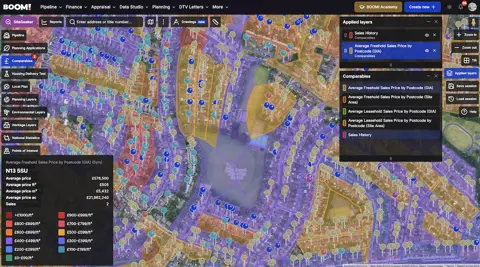
Driving for dollars finds you the sites everyone else driving past has also seen. Searching finds you the ones nobody has. Filter on the criteria that define your strategy — plot size, ownership type, designation, use class, last sold date — and you get a list of candidates that was never advertised. Our guide to finding off-market sites without an agent covers the three routes and what each costs.

Step 5: buy the expertise you do not have
Nobody does this alone. Before your first offer you want a planning consultant who knows the authority, an architect who has got schemes through it, a solicitor who does development land rather than conveyancing, and a builder who will price properly.
A pre-application enquiry to the council is usually the cheapest opinion you will buy all year. It is not binding, and officers are careful about that, but a clear steer at pre-app stage is worth more than weeks of your own reading.
The two things to sort out this month
First, check your employment contract. Exclusivity, conflict of interest and outside business clauses are common, and finding out about one after your first deal is a bad way to find out. Ask your employer if you are unsure.
Second, understand the tax position before you earn anything. There is a £1,000 trading allowance, and if your gross trading income goes over it you generally have to register for Self Assessment — see HMRC’s guidance on trading allowances. Development profit is taxed differently depending on whether you are trading or investing, and whether you hold personally or through a company. That is a conversation with an accountant, not a blog post.
Where to start this week
Pick one local authority. Read its local plan policies on housing and its settlement boundaries. Then find ten sites inside that area that fit one simple strategy, and write down for each one why the council could refuse it. If you cannot answer that question, you are not ready to spend money — and you have just saved yourself the cost of finding out the expensive way.