An off-market development site is one nobody has advertised: no listing, no agent, no competing bids. You find it by working out who owns a piece of land and asking them, rather than waiting to be told it is for sale.
This post covers the three routes that actually work, what each one costs, and what to say when you write to an owner.
Why off-market sites are worth the extra work
By the time a site is listed, the price reflects the competition for it. An owner who has not decided to sell is negotiating with one person — you — and the conversation is about their timing and their tax position rather than about beating someone else’s offer.
The other advantage is sequencing. Off-market, you can agree terms before you spend on planning.
Route 1: find the owner through HM Land Registry
Most land in England and Wales is registered, and the register is public. You can download the title register and title plan for any registered title through the Search for property information service. The register gives you the registered proprietor, their address for service, the price paid where it was recorded after April 2000, and any restrictions or charges.
It costs £7 per title register and £7 per title plan. That went up from £3 on 9 December 2024 under the Land Registration Fee Order 2024, the first increase in over a decade — so if you budgeted this at £3 a title, your sourcing costs have more than doubled and you may not have noticed. An official copy by post is £11.
At £14 for register and plan, a hundred-title shortlist is £1,400. That is the real argument for filtering hard before you start buying documents.
Route 2: read the planning history
Planning records tell you things about a site that no listing ever will:
- Refusals and withdrawals. An owner who tried for permission and failed has already decided they want to sell or develop. They now need someone who can solve the problem that stopped them.
- Lapsed permissions. A consent that was never implemented is an owner whose plan did not come off.
- Pre-application activity and allocations. Land somebody is already testing.
- Neighbouring approvals. A scheme approved next door is the strongest argument you will get that yours is acceptable in principle.
Doing this council by council is the bottleneck. BOOM! holds 20 million planning applications across 400+ UK authorities in one search, which is the version of this job that fits round a full-time job.
Route 3: search the land itself
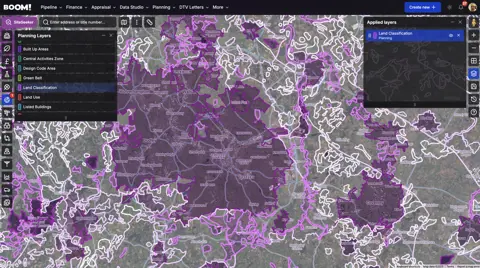
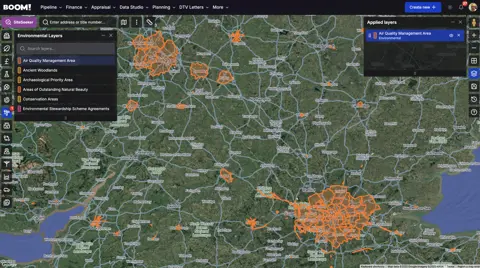
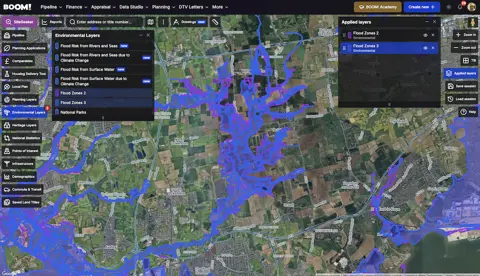
The first two routes start from a site and work outwards. This one starts from your criteria and finds the sites. Filter 30 million land titles across England, Wales and Scotland by plot size, ownership type, planning designation, use class, last sold date and the rest, and you get a shortlist of land that fits your strategy — none of which is advertised anywhere.
Where you point that search matters as much as how you filter it. Two places worth learning properly: the edge of a settlement boundary, where the principle of development is arguable, and brownfield land, where policy is on your side and most competitors have already assumed it is too complicated.
How to approach a landowner
Keep it short, be specific about the land, and give them one easy thing to do. A letter that reads like a mail-merge gets treated like one.
Dear [Name],
I am writing about the land at [address], which I believe you own — I have marked it on the enclosed plan so you know which parcel I mean.
I work with small developers in [area] and we are looking for sites of this size. I am not an agent and there would be no fee to you.
If you would ever consider selling, or a joint venture, I would welcome a short conversation. If not, I will not write again.
[Your name, phone, email]
Three things make the difference:
- Include a plan with the boundary marked. It proves you mean their land and not a circular.
- Say what you are not. Most owners assume any letter about their land is from an agent chasing an instruction.
- Follow up. Most replies come from the second or third letter. One letter and silence is not a test of the strategy.
One thing to check before you charge a fee
If you introduce a buyer to a seller for a fee — sourcing deals for someone else, rather than buying them yourself — HMRC generally treats that as estate agency work. You must register with HMRC for money laundering supervision before you start trading, and it is a criminal offence to trade as an estate agency business without registering. Residential agency work also requires membership of a government-approved redress scheme. Buying for your own account is a different position. Check where you sit before you invoice anyone.
What to do next
Pick one area you can drive to, set your criteria, and build a list of twenty titles that fit. Buy the registers for the five best. Write to all five, and write again three weeks later. That is a complete off-market campaign, and it costs under £100.
When it works, the next question is how to structure the deal so you are not buying land without permission — our guide to the four ways to structure a land deal covers that.