Housing within reasonable walking distance of a well-connected station now starts from yes. That is no longer a proposal: it is national policy, in force since the National Planning Policy Framework published on 17 August 2026. This post sets out exactly which stations count, how far “reasonable walking distance” actually is, the four tests a scheme has to meet, and the minimum density that comes attached.
The distance is the easy part to remember and the easy part to get wrong. It is around 800 metres, and it is measured for part of a site as well as the whole. Everything else needs reading properly.
What counts as a well-connected station
The Framework’s glossary defines it, and the definition is narrower than “there is a station”. A well-connected station is a railway station, or an underground, tram or light rail stop, that meets both of these:
- It sits within one of the top 80 Travel to Work Areas located partially or fully within England, ranked by Gross Value Added.
- On the normal weekday timetable, it is served throughout the daytime by at least four trains or trams per hour overall, or at least two per hour in any one direction – or has a reasonable prospect of being so served through planned upgrades or agreement with the rail operator.
Both limbs matter. A four-an-hour station in a low-GVA travel to work area does not qualify. Nor does a station in a major city that only sees an hourly service. The frequency test is checkable in an afternoon against a public timetable, and it is worth checking before you make an offer.
How far is “reasonable walking distance”
The Framework defines it for these policies as around 800 metres, or around 10 minutes’ walk time where topography, route availability and quality, or physical barriers would prevent or discourage walking from up to 800 metres away.
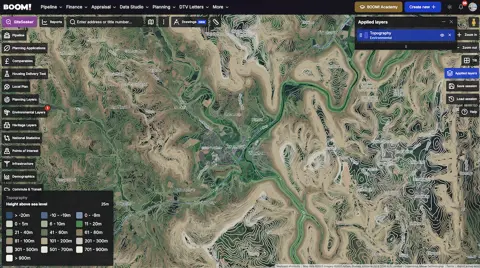
Note what that second limb does. A dual carriageway, a river with no crossing, or a steep bank between the site and the station can pull the effective distance well inside 800 metres. A crow-flies buffer is a starting point, not an answer.
And the detail most people miss: where only part of a site falls within reasonable walking distance, the policy applies only to that part. On a large site, the default yes may cover the half nearest the station and nothing beyond it. That changes how you draw a red line.
The four tests a scheme has to meet
The same four criteria appear in two places: policy S5, for development outside settlements, and policy GB7, for development in the Green Belt. Residential or mixed-use development must:
- Be within reasonable walking distance of a well-connected station.
- Be physically well-related to the station, or to the settlement the station sits in.
- Be of a scale that can be accommodated, taking into account the existing or proposed availability of infrastructure.
- Not prejudice any proposals for long-term comprehensive development in the same location.
Under policy S5, development of this kind outside settlements should be approved unless the benefits of doing so would be substantially outweighed by any adverse effects, assessed against the Framework’s national decision-making policies. That is the default yes, and “substantially outweighed” is a high bar for an objector.
Under policy GB7, the same development is not inappropriate development in the Green Belt – which removes the very obstacle that has historically killed these sites. Major housing schemes on Green Belt land still have to comply with the Golden Rules on affordable housing and infrastructure under policy GB8, so price that in. The Green Belt guide covers how those rules work.
The density you are required to hit
The default yes comes with an obligation, not just a permission. Policy L3 sets minimum densities for residential and mixed-use schemes within reasonable walking distance of a well-connected station:
- At least 35 dwellings per hectare within the net developable area of the site.
- At least 45 dwellings per hectare where the service frequency is at least twice the minimum required for a well-connected station – so eight or more trains or trams an hour overall.
Exceptions are narrow: sites below the threshold for major development where meeting the standard can be shown to be inappropriate or impossible, and traveller sites. And policy L3 is explicit that proposals which do not make efficient use of land should be refused.
The commercial read is straightforward. Ten low-density houses on a hectare near a qualifying station is no longer a scheme. Thirty-five flats and townhouses is. If your appraisal was built on detached units, rebuild it before you bid.
Finding the sites this applies to
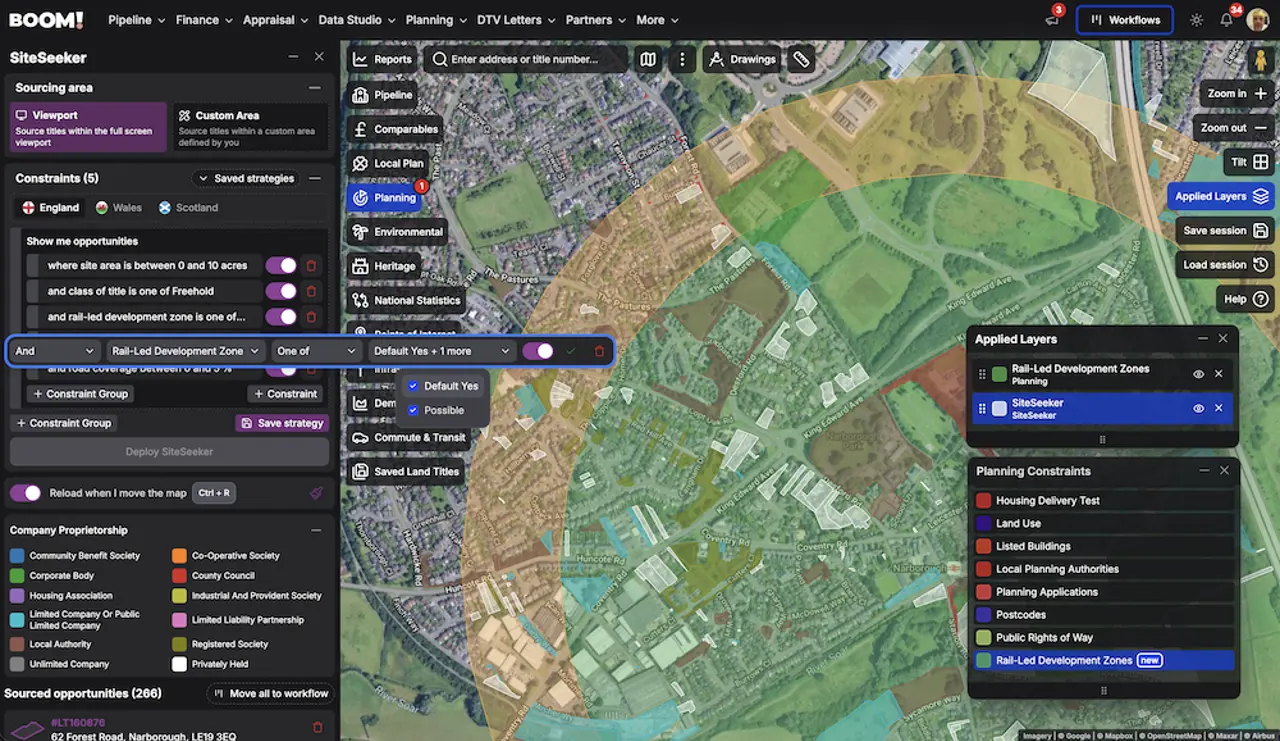
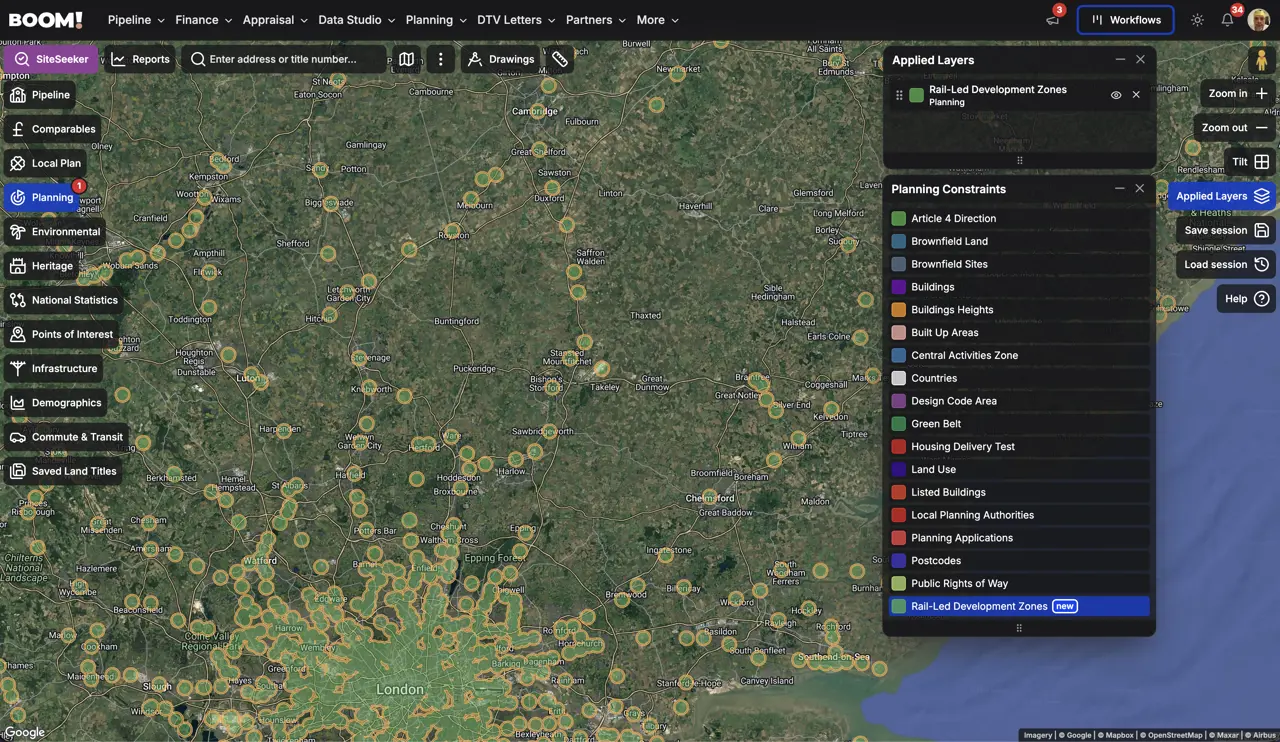
BOOM! carries a Rail-Led Development Zones layer, which classifies land around stations into two bands:
- Default Yes – within 800 metres, matching the Framework’s reasonable walking distance.
- Possible – more than 800 and up to 1,000 metres. This is our own outer band, not a policy threshold. It exists because the 800 metre figure is “around” 800 metres and because a site straddling the line is worth looking at. Do not present it to a planning officer as policy support.
The same classification is a SiteSeeker constraint, so you can filter a search area down to land in the Default Yes band and then layer the rest of your criteria on top – brownfield land, land use, title ownership, sold prices, flood risk. Ownership comes with the title, which is what makes a direct-to-vendor approach possible before a site is ever marketed.
Two checks the layer cannot do for you. It does not test the timetable, so confirm the service frequency and the travel to work area for yourself. And it measures distance, not walkability – walk the route, or at least look at what is in the way.
Why this favours off-market
A policy change this legible is read by everyone. Once a site within 800 metres of a qualifying station is openly marketed, it is priced for the default yes and the margin has moved to the seller. The value is in reaching a landowner who has not yet connected their field, car park or yard to a policy change in August.
That is a sourcing problem rather than a planning one – see finding off-market sites without relying on agents.
What the default yes does not switch off
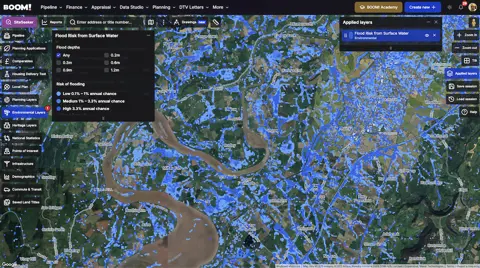
It answers “why here?”. It answers nothing else. Flood risk, heritage, nutrient neutrality, highways and design all apply unchanged, and any of them can still refuse you.
Flood risk is the one most likely to bite, because station land is often low-lying: a site-specific flood risk assessment is required in Flood Zones 2, 3a and 3b, and in Flood Zone 1 for any site of a hectare or more. Check it before you get attached – the flood zones guide sets out which tests each zone triggers. In catchments with a nutrient issue, nutrient neutrality will still hold up a determination regardless of how well connected the station is.